The Predominant Languages Spoken on Madagascar Are Not of an African Language Family, but Belong to:

A simplistic view of language families spoken in Africa:
Bantu
The languages of Africa are divided into several major linguistic communication families:
- Niger–Congo or perhaps Atlantic–Congo languages (includes Bantu and not-Bantu, and possibly Mande and others) are spoken in West, Central, Southeast and Southern Africa.
- Afroasiatic languages are spread throughout Western Asia, North Africa, the Horn of Africa and parts of the Sahel.
- Indo-European languages are spoken in South Africa and Namibia (Afrikaans, English, High german) and are used as lingua francas in the former colonies of Britain and Liberia that was part of American Colonization Social club (English), former colonies of France and of Belgium (French), former colonies of Portugal (Portuguese), quondam colonies of Italy (Italian), former colonies of Espana (Spanish) and the current Spanish territories of Ceuta, Melilla and the Canary Islands and the current French territories of Mayotte and La Réunion.
- Various families of Nilo-Saharan languages (unity debated) are spoken from Tanzania to Eritrea and Sudan and from Republic of chad to Mali.
- Austronesian languages are spoken in Republic of madagascar.
- Khoe–Kwadi languages are spoken principally in Namibia and Botswana.
At that place are several other minor families and language isolates, besides as creoles and languages that have nonetheless to exist classified. In addition, Africa has a wide variety of sign languages, many of which are language isolates.
The total number of languages natively spoken in Africa is variously estimated (depending on the delineation of language vs. dialect) at between 1,250 and 2,100,[1] and by some counts at over three,000.[2] Nigeria lonely has over 500 languages (according to SIL Ethnologue),[3] 1 of the greatest concentrations of linguistic diversity in the world. Nonetheless, "One of the notable differences between Africa and nigh other linguistic areas is its relative uniformity. With few exceptions, all of Africa's languages have been gathered into four major phyla."[iv]
Around a hundred languages are widely used for inter-indigenous communication. Standard arabic, Somali, Berber, Amharic, Oromo, Igbo, Swahili, Hausa, Manding, Fulani and Yoruba are spoken past tens of millions of people. Twelve dialect clusters (which may group up to a hundred linguistic varieties) are spoken by 75 percentage, and xv by 85 percent, of Africans every bit a first or additional linguistic communication.[5] Although many mid-sized languages are used on the radio, in newspapers and in primary-schoolhouse education, and some of the larger ones are considered national languages, only a few are official at the national level. The African Spousal relationship declared 2006 the "Yr of African Languages".[6]
Language groups [edit]

Clickable map showing the traditional linguistic communication families, subfamilies and major languages spoken in Africa
Most languages spoken in Africa belong to i of three large language families: Afroasiatic, Nilo-Saharan and Niger–Congo. Another hundred belong to smaller families such as Ubangian (sometimes grouped within Niger-Congo) and the various families called Khoisan, or the Indo-European and Austronesian linguistic communication families mainly spoken outside Africa; the presence of the latter two dates to 2,600 and 1,500 years ago, respectively. In addition, the languages of Africa include several unclassified languages and sign languages.
The primeval Afroasiatic languages are associated with the Capsian civilisation, the Nilo-Saharan languages are linked with the Khartoum Mesolithic/Neolithic, the Niger-Congo languages are correlated with the west and cardinal African hoe-based farming traditions and the Khoisan languages are matched with the south and southeastern Wilton industries.[vii] More broadly, the Afroasiatic family unit is tentatively grouped within the Nostratic superfamily, and the Nilo-Saharan and Niger-Congo phyla form the Niger-Saharan macrophylum.[8]
Afroasiatic languages [edit]
Afroasiatic languages are spoken throughout North Africa, the Horn of Africa, Western asia and parts of the Sahel. There are approximately 375 Afroasiatic languages spoken by over 400 million people. The chief subfamilies of Afroasiatic are Berber, Chadic, Cushitic, Omotic, Egyptian and Semitic. The Afroasiatic Urheimat is uncertain. The family unit's nearly extensive branch, the Semitic languages (including Arabic, Amharic and Hebrew amid others), is the only branch of Afroasiatic that is spoken outside Africa.[9]
Some of the virtually widely spoken Afroasiatic languages include Standard arabic (a Semitic language, and a contempo arrival from West Asia), Somali (Cushitic), Berber (Berber), Hausa (Chadic), Amharic (Semitic) and Oromo (Cushitic). Of the earth'due south surviving language families, Afroasiatic has the longest written history, as both the Akkadian linguistic communication of Mesopotamia and Ancient Egyptian are members.
Nilo-Saharan languages [edit]
Nilo-Saharan languages consist of a hundred diverse languages. The proposed family unit has a spoken language expanse that stretches from the Nile Valley to northern Tanzania and into Nigeria and DR Congo, with the Songhay languages along the middle reaches of the Niger River as a geographic outlier. Genetic linkage between these languages has non been conclusively demonstrated, and among linguists, back up for the proposal is sparse.[10] [eleven] The languages share some unusual morphology, but if they are related, most of the branches must have undergone major restructuring since diverging from their common ancestor. The inclusion of the Songhay languages is questionable, and doubts have been raised over the Koman, Gumuz and Kadu branches.
Some of the amend known Nilo-Saharan languages are Kanuri, Fur, Songhay, Nobiin and the widespread Nilotic family unit, which includes the Luo, Dinka and Maasai. The Nilo-Saharan languages are tonal.
Niger–Congo languages [edit]

Map showing the traditional language families represented in Africa:
Niger-Congo:
Key and Eastern Sudanese
Central Bantoid
Eastern Bantoid
Guinean
Western Bantoid
Nilo-Saharan:
The Niger–Congo languages constitute the largest language family spoken in West Africa and perhaps the world in terms of the number of languages. 1 of its salient features is an elaborate noun class system with grammatical concord. A large majority of languages of this family are tonal such as Yoruba and Igbo, Akan and Ewe language. A major branch of Niger–Congo languages is the Bantu phylum, which has a wider speech area than the rest of the family (see Niger–Congo B (Bantu) in the map to a higher place).
The Niger–Kordofanian linguistic communication family, joining Niger–Congo with the Kordofanian languages of due south-central Sudan, was proposed in the 1950s past Joseph Greenberg. Today, linguists often use "Niger–Congo" to refer to this entire family, including Kordofanian as a subfamily. Ane reason for this is that it is non clear whether Kordofanian was the first branch to diverge from rest of Niger–Congo. Mande has been claimed to be as or more divergent. Niger–Congo is mostly accepted past linguists, though a few question the inclusion of Mande and Dogon, and there is no conclusive bear witness for the inclusion of Ubangian.
Other language families [edit]
Several languages spoken in Africa vest to language families concentrated or originating outside the African continent.
Austronesian [edit]
Malagasy belongs to the Austronesian languages and is the westernmost branch of the family. Information technology is the national and co-official language of Madagascar and one of Malagasy dialects called Bushi is besides spoken in Mayotte.
The ancestors of the Malagasy people migrated to Madagascar around 1,500 years agone from Southeast Asia, more specifically the island of Borneo. The origins of how they arrived to Republic of madagascar remains a mystery, withal the Austronesians are known for their seafaring civilization. Despite the geographical isolation, Malagasy still has strong resemblance to Barito languages peculiarly the Ma'anyan language of southern Borneo.
With more than 20 one thousand thousand speakers, Malagasy is one of the most widely spoken of the Austronesian languages.
Indo-European [edit]
Afrikaans is Indo-European, every bit is almost of the vocabulary of almost African creole languages. Afrikaans evolved from the Dutch vernacular[12] [13] of South Holland (Hollandic dialect)[14] [15] spoken past the mainly Dutch settlers of what is at present Southward Africa, where it gradually began to develop distinguishing characteristics in the course of the 18th century, including the loss of verbal conjugation (save for 5 modal verbs), likewise equally grammatical case and gender.[16] Most Afrikaans speakers alive in South Africa. In Namibia it is the lingua franca. Overall 15 to xx million people are estimated to speak Afrikaans.
Since the colonial era, Indo-European languages such every bit Afrikaans, English, French, Italian, Portuguese and Spanish have held official condition in many countries, and are widely spoken, by and large as lingua francas. (See African French and African Portuguese.) High german was in one case used in Frg's colonies there from the tardily 1800s until Globe War I, when Britain and French republic took over and revoked German'due south official condition. Despite this, German language is still spoken in Namibia, mostly amid the white population. Although it lost its official status in the 1990s, it has been redesignated every bit a national language. Indian languages such as Gujarati are spoken by S Asian expatriates exclusively. In earlier historical times, other Indo-European languages could be found in various parts of the continent, such as Quondam Persian and Greek in Egypt, Latin and Vandalic in N Africa and Modern Persian in the Horn of Africa.
Small families [edit]
The three small Khoisan families of southern Africa have not been shown to be closely related to whatever other major linguistic communication family. In add-on, in that location are diverse other families that have not been demonstrated to vest to one of these families. (The questionable branches of Nilo-Saharan were covered higher up, and are not repeated here.)
- Mande, some 70 languages, including the major languages of Mali and Republic of guinea. These are generally idea to be divergent Niger–Congo, but debate persists.
- Ubangian, some 70 languages, centered on the languages of the Central African Democracy; may be Niger–Congo
- Khoe, around 10 languages, the master family of Khoisan languages of Namibia and Botswana
- Sandawe, an isolate of Tanzania, mayhap related to Khoe
- Kx'a, a language of Southern Africa
- Tuu, or Taa-ǃKwi, ii surviving languages
- Hadza, an isolate of Tanzania
- Bangime, a likely isolate of Republic of mali
- Jalaa, a probable isolate of Nigeria
- Laal, a possible isolate of Chad
Khoisan is a term of convenience covering some 30 languages spoken by around 300,000–400,000 people. There are v Khoisan families that have not been shown to be related to each other: Khoe, Tuu and Kx'a, which are found mainly in Namibia and Botswana, as well as Sandawe and Hadza of Tanzania, which are language isolates. A striking feature of Khoisan languages, and the reason they are frequently grouped together, is their utilise of click consonants. Some neighbouring Bantu languages (notably Xhosa and Zulu) have clicks likewise, merely these were adopted from Khoisan languages. The Khoisan languages are too tonal.
Creole languages [edit]
Due partly to its multilingualism and its colonial past, a substantial proportion of the globe's creole languages are to exist plant in Africa. Some are based on Indo-European languages (e.1000. Krio from English language in Sierra Leone and the very similar Pidgin in Nigeria, Ghana and parts of Republic of cameroon; Greatcoat Verdean Creole in Cape Verde and Guinea-Bissau Creole in Republic of guinea-bissau and Senegal, all from Portuguese; Seychellois Creole in the Seychelles and Mauritian Creole in Republic of mauritius, both from French); some are based on Arabic (e.g. Juba Arabic in the southern Sudan, or Nubi in parts of Republic of uganda and Kenya); some are based on local languages (eastward.g. Sango, the primary language of the Central African Republic); while in Cameroon a creole based on French, English and local African languages known as Camfranglais has started to become popular.
Unclassified languages [edit]
A off-white number of unclassified languages are reported in Africa. Many remain unclassified merely for lack of data; among the better-investigated ones that continue to resist piece of cake classification are:
- possibly Afroasiatic: Ongota, Gomba
- possibly Nilo-Saharan: Shabo
- perchance Niger–Congo: Jalaa, Mbre, Bayot
- possibly Khoe: Kwadi
- unknown: Laal, Mpre
Of these, Jalaa is perhaps the nearly likely to exist an isolate.
Less-well investigated languages include Irimba, Luo, Mawa, Rer Bare (possibly Bantu), Bete (evidently Jukunoid), Bung (unclear), Kujarge (plain Chadic), Lufu (Jukunoid), Meroitic (possibly Afroasiatic), Oropom (perhaps spurious) and Weyto (evidently Cushitic). Several of these are extinct, and acceptable comparative information is thus unlikely to be forthcoming. Hombert & Philippson (2009)[17] list a number of African languages that have been classified every bit linguistic communication isolates at i betoken or another. Many of these are but unclassified, only Hombert & Philippson believe Africa has virtually xx language families, including isolates. Abreast the possibilities listed higher up, in that location are:
- Aasax or Aramanik (Tanzania) (S Cushitic? contains non-Cushitic lexicon)
- Imeraguen (Islamic republic of mauritania) - Hassaniyya Arabic restructured on an Azêr (Soninke) base
- Kara (Fer?) (Central African Democracy)
- Oblo (Cameroon) (Adamawa? Extinct?)
Roger Cringe notes a couple additional possibilities:
- Defaka (Nigeria)
- Dompo (Ghana)
Below is a listing of language isolates and otherwise unclassified languages in Africa, from Vossen & Dimmendaal (2020:434):[18]
| Linguistic communication | Country |
|---|---|
| Bangi Me | Mali |
| Bayot | Senegal |
| Dompo | Ghana |
| Ega | Republic of cote d'ivoire |
| Gomba | Federal democratic republic of ethiopia |
| Gumuz | Ethiopia, Sudan |
| Hadza | Tanzania |
| Irimba | Gabon |
| Jalaa | Nigeria |
| Kujarge | Chad |
| Laal | Chad |
| Lufu | Nigeria |
| Luo | Cameroon |
| Mawa | Nigeria |
| Meyobe | Republic of benin, Togo |
| Mimi of Decorse; Mimi of Nachtigal | Chad |
| Mpra | Ghana |
| Oblo | Cameroon |
| Ongota | Federal democratic republic of ethiopia |
| Oropom | Kenya, Republic of uganda |
| Rer Bare | Ethiopia |
| Shabo | Ethiopia |
| Weyto | Ethiopia |
| Wutana | Nigeria |
| Yeni | Cameroon |
Sign languages [edit]
Many African countries have national sign languages, such equally Algerian Sign Language, Tunisian Sign Language, Ethiopian Sign Linguistic communication. Other sign languages are restricted to small areas or single villages, such as Adamorobe Sign Language in Republic of ghana. Tanzania has seven, one for each of its schools for the Deafened, all of which are discouraged. Not much is known, since footling has been published on these languages
Sign linguistic communication systems extant in Africa include the Paget Gorman Sign Arrangement used in Namibia and Angola, the Sudanese Sign languages used in Sudan and South Sudan, the Arab Sign languages used across the Arab Mideast, the Francosign languages used in Francophone Africa and other areas such as Republic of ghana and Tunisia, and the Tanzanian Sign languages used in Tanzania.
Language in Africa [edit]
Throughout the long multilingual history of the African continent, African languages have been subject to phenomena similar language contact, language expansion, language shift and linguistic communication death. A case in point is the Bantu expansion, in which Bantu-speaking peoples expanded over most of Sub-Equatorial Africa, intermingling with Khoi-San speaking peoples from much of Southeast Africa and Southern Africa and other peoples from Central Africa. Another example is the Arab expansion in the 7th century, which led to the extension of Arabic from its homeland in Asia, into much of Northward Africa and the Horn of Africa.
Merchandise languages are another age-erstwhile phenomenon in the African linguistic landscape. Cultural and linguistic innovations spread along trade routes and languages of peoples dominant in trade adult into languages of wider communication (lingua franca). Of detail importance in this respect are Berber (North and West Africa), Jula (western West Africa), Fulfulde (West Africa), Hausa (West Africa), Lingala (Congo), Swahili (Southeast Africa), Somali (Horn of Africa) and Arabic (North Africa and Horn of Africa).
Afterwards gaining independence, many African countries, in the search for national unity, selected i language, generally the erstwhile colonial language, to be used in government and education. Notwithstanding, in recent years, African countries have become increasingly supportive of maintaining linguistic variety. Language policies that are being developed nowadays are mostly aimed at multilingualism.
Official languages [edit]
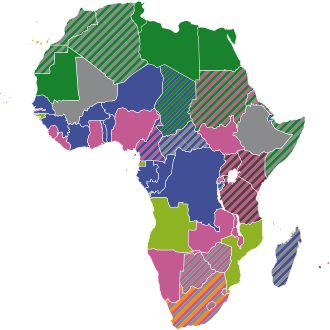
Official languages in Africa:
Besides the former colonial languages of English, French, Portuguese, Dutch (Afrikaans) and Spanish, the following languages are official at the national level in Africa (non-exhaustive list):
- Afroasiatic
- Standard arabic in Algeria, Chad, Comoros, Djibouti, Egypt, Libya, Mauritania,[19] Morocco, Somalia,[20] Sudan, Tunisia and Zanzibar (Tanzania)
- Berber in Kingdom of morocco and People's democratic republic of algeria[21]
- Amharic, Oromo, Afar, Tigrigna, and Somali in Ethiopia
- Somali in Somalia, Federal democratic republic of ethiopia, Republic of kenya, and Djibouti
- Tigrinya in Ethiopia and Eritrea
- Austronesian
- Malagasy in Madagascar
- French Creole
- Seychelles Creole in Republic of seychelles
- Indo-European
- Afrikaans in South Africa
- Niger-Congo
- Chewa in Malawi and Republic of zimbabwe
- Comorian in the Comoros
- Kongo in Republic of angola, Congo-kinshasa, Gabonese republic, and Commonwealth of the Congo
- Kinyarwanda in Rwanda
- Kirundi in Republic of burundi
- Sesotho in Lesotho, S Africa and Zimbabwe
- Setswana/Tswana in Botswana and South Africa
- Shona, Sindebele in Zimbabwe
- Sepedi in S Africa
- Ndebele in Due south Africa[22]
- Swahili in Tanzania, Republic of kenya, Rwanda and Uganda
- Swati in Eswatini (Swaziland) and South Africa
- Tsonga in Due south Africa
- Venda in South Africa
- Xhosa in South Africa
- Zulu in South Africa
| Language | Family unit | Official status per state |
|---|---|---|
| Afrikaans | Indo-European | South Africa |
| Amharic | Afroasiatic | Federal democratic republic of ethiopia |
| Standard arabic | Afroasiatic | Algeria, Union of the comoros, Republic of chad, Djibouti, Arab republic of egypt, Eritrea, Libya, Mauritania, Morocco, Somalia, Sudan, |
| Berber | Afroasiatic | Algeria, Morocco, Libya |
| Chewa | Niger-Congo | Malawi, Zimbabwe |
| Comorian | Niger-Congo | Comoros |
| Kikongo | Niger-Congo | Republic of angola, Congo-kinshasa, Republic of the Congo |
| Kinyarwanda | Niger-Congo | Rwanda |
| Kirundi | Niger-Congo | Burundi |
| Malagasy | Austronesian | Republic of madagascar |
| Ndebele | Niger-Congo | S Africa |
| Oromo | Afroasiatic | Ethiopia[23] [24] [25] |
| Sepedi | Niger-Congo | South Africa |
| Sesotho | Niger-Congo | Lesotho, Due south Africa, Zimbabwe |
| Setswana/Tswana | Niger-Congo | Botswana, S Africa |
| Republic of seychelles Creole | French Creole | Seychelles |
| Shona | Niger-Congo | Zimbabwe |
| Sindebele | Niger-Congo | Zimbabwe |
| Somali | Afroasiatic | Somalia, Djibouti |
| Swahili | Niger-Congo | Republic of kenya, Rwanda, Tanzania, Republic of uganda |
| Swati | Niger-Congo | Eswatini, S Africa |
| Tigrinya | Afroasiatic | Federal democratic republic of ethiopia, Eritrea |
| Tsonga | Niger-Congo | South Africa |
| Venda | Niger-Congo | Due south Africa |
| Xhosa | Niger-Congo | South Africa |
| Zulu | Niger-Congo | South Africa |
Cantankerous-border languages [edit]
The colonial borders established by European powers following the Berlin Conference in 1884–1885 divided a nifty many ethnic groups and African language speaking communities. This can cause divergence of a linguistic communication on either side of a border (especially when the official languages are unlike), for instance, in orthographic standards. Some notable cross-border languages include Berber (which stretches across much of North Africa and some parts of Due west Africa), Kikongo (that stretches across northern Angola, western and coastal Democratic republic of the congo, and western and coastal Democracy of the Congo), Somali (stretches across most of the Horn of Africa), Swahili (spoken in the African Great Lakes region), Fula (in the Sahel and West Africa) and Luo (in Autonomous Congo-brazzaville, Federal democratic republic of ethiopia, Kenya, Tanzania, Uganda, Southward Sudan and Sudan).
Some prominent Africans such every bit sometime Malian president and old Chairman of the African Commission, Alpha Oumar Konaré, have referred to cantankerous-border languages every bit a factor that can promote African unity.[26]
Language modify and planning [edit]
Linguistic communication is not static in Africa any more than on other continents. In addition to the (likely modest) impact of borders, in that location are besides cases of dialect levelling (such as in Igbo and probably many others), koinés (such every bit N'Ko and perhaps Runyakitara) and emergence of new dialects (such equally Sheng). In some countries, there are official efforts to develop standardized language versions.
In that location are also many less widely spoken languages that may exist considered endangered languages.
Demographics [edit]
Of the 1 billion Africans (in 2009), most 17 percentage speak an Arabic dialect.[ commendation needed ] Virtually ten percent speak Swahili,[ citation needed ] the lingua franca of Southeast Africa; about 5 pct speak a Berber dialect;[ citation needed ] and about 5 percent speak Hausa, which serves as a lingua franca in much of the Sahel. Other important West African languages are Yoruba, Igbo, Akan and Fula. Major Horn of Africa languages are Somali, Amharic and Oromo. Important South African languages are Sotho, Tswana, Pedi, Venda, Tsonga, Swazi, Southern Ndebele, Zulu, Xhosa and Afrikaans.[27]
English, French and Portuguese are important languages in Africa. About 130 one thousand thousand, 115 million and 35 million Africans, respectively, speak them as either native or secondary languages. Portuguese has become the national linguistic communication of Angola and São Tomé and Príncipe, and Portuguese is the official language of Mozambique. The economies of Angola and Mozambique are speedily becoming economical powerhouses in Africa.[28] Through (amidst other factors) sheer demographic weight, Africans are increasingly taking ownership[ citation needed ] of these three world languages as they are having an ever-greater influence on the enquiry, economic growth and development in the African countries where English, French and Portuguese are spoken.
Linguistic features [edit]
Some linguistic features are peculiarly common among languages spoken in Africa, whereas others are less common. Such shared traits probably are not due to a common origin of all African languages. Instead, some may exist due to language contact (resulting in borrowing) and specific idioms and phrases may exist due to a similar cultural groundwork.
Phonological [edit]
Some widespread phonetic features include:
- certain types of consonants, such as implosives (/ɓa/), ejectives (/kʼa/), the labiodental flap and in southern Africa, clicks (/ǂa/, /ᵑǃa/). True implosives are rare outside Africa, and clicks and the flap almost unheard of.
- doubly articulated labial-velar stops similar /k͡pa/ and /ɡ͡ba/ are found in places s of the Sahara.
- prenasalized consonants, similar /mpa/ and /ŋɡa/, are widespread in Africa just non common outside it.
- sequences of stops and fricatives at the beginnings of words, such as /fsa/, /pta/ and /dt͡sk͡xʼa/.
- nasal stops which only occur with nasal vowels, such as [ba] vs. [mã] (only both [pa] and [pã]), specially in West Africa.
- vowels contrasting an advanced or retracted tongue, commonly called "tense" and "lax".
- unproblematic tone systems which are used for grammatical purposes.
Sounds that are relatively uncommon in African languages include uvular consonants, diphthongs and front rounded vowels
Tonal languages are found throughout the world but are predominantly used in Africa. Both the Nilo-Saharan and the Khoi-San phyla are fully tonal. The large majority of the Niger–Congo languages are likewise tonal. Tonal languages are as well found in the Omotic, Chadic and South & Due east Cushitic branches of Afroasiatic. The nearly common type of tonal system opposes two tone levels, High (H) and Low (Fifty). Contour tones do occur, and can often exist analysed as ii or more tones in succession on a single syllable. Tone melodies play an important role, meaning that information technology is often possible to country significant generalizations past separating tone sequences ("melodies") from the segments that bear them. Tonal sandhi processes like tone spread, tone shift, downstep and downdrift are common in African languages.
Syntactic [edit]
Widespread syntactical structures include the mutual utilise of adjectival verbs and the expression of comparing by means of a verb 'to surpass'. The Niger–Congo languages take large numbers of genders (substantive classes) which cause understanding in verbs and other words. Case, tense and other categories may exist distinguished only by tone. Auxiliary verbs are also widespread among African languages; the fusing of subject field markers and TAM/polarity auxiliaries into what are known as tense pronouns are more common in auxiliary verb constructions in African languages than in most other parts of the earth.[29]
Semantic [edit]
Quite oftentimes, but one term is used for both animal and meat; the give-and-take nama or nyama for animate being/meat is particularly widespread in otherwise widely divergent African languages.
Demographics [edit]
The following is a table displaying the number of speakers of given languages inside Africa:
| Language | Family unit | Native speakers (L1) | Official status per country |
|---|---|---|---|
| Abron | Niger–Congo | ane,393,000[30] | Ghana |
| Afar | Afroasiatic | Spoken in Republic of djibouti, Eritrea, Ethiopia | |
| Afrikaans | Indo-European | vii,200,000[31] | National linguistic communication in Namibia, co-official in South Africa |
| Akan | Niger–Congo | xi,000,000[32] | None. Authorities sponsored linguistic communication of Ghana |
| Amharic | Afroasiatic | 21,800,000[33] | Ethiopia |
| Standard arabic | Afroasiatic | 150,000,000[34] but with separate mutually unintelligible varieties | Algeria, Chad, Comoros, Djibouti, Egypt, Libya, Mauritania, Morocco, Sahrawi Arab Democratic Republic, Somalia, Sudan, Tanzania (Zanzibar), Tunisia |
| Berber | Afroasiatic | xvi,000,000[35] (estimated) (including separate mutually unintelligible varieties) | Morocco, Algeria |
| Bhojpuri | Indo-European | 65,300[36] | Spoken in Mauritius |
| Greatcoat Verdean Creole | Portuguese Creole | National language in Cape Verde | |
| Chewa | Niger–Congo | ix,700,000[37] | Malawi, Zimbabwe |
| Comorian | Niger–Congo | Union of the comoros | |
| Dangme | Niger–Congo | 1,020,000[38] | Ghana |
| English language | Indo-European | 6,500,000[39] (estimated) | Run into List of territorial entities where English is an official language |
| Fon | Niger–Congo | Benin | |
| French | Indo-European | 1,200,000[forty] (estimated) | Run into List of territorial entities where French is an official language and African French |
| Fulani | Niger–Congo | 25,000,000[32] | National language of Senegal |
| Ga | Niger–Congo | Ghana | |
| High german | Indo-European | National language of Namibia, special condition in South Africa | |
| Gikuyu | Niger–Congo | 8,100,000[41] | Spoken in Kenya |
| Hausa | Afroasiatic | 48,637,300[42] | Recognized in Nigeria, Republic of ghana, Niger |
| Hindi | Indo-European | Spoken in Mauritius | |
| Igbo | Niger–Congo | 27,000,000[43] | Native in Nigeria |
| Italian | Indo-European | Recognized in Eritrea and Somalia | |
| Khoekhoe | Khoe | 300,000[44] | National language of Namibia |
| Kimbundu | Niger–Congo | Angola | |
| Kinyarwanda | Niger–Congo | nine,800,000[32] | Rwanda |
| Kirundi | Niger–Congo | viii,800,000[32] | Burundi |
| Kituba | Kongo-based creole | Autonomous Republic of Congo, Republic of Congo | |
| Kongo | Niger–Congo | five,600,000[45] | Angola, recognised national language of Republic of Congo and Democratic Democracy of Congo |
| Lingala | Niger–Congo | 5,500,000[32] | National language of Democratic Republic of Congo, Democracy of Congo |
| Luganda | Niger–Congo | 4,100,000[46] | Native language of Uganda |
| Luo | Nilo-Saharan (probable) | 5,000,000[47] | Republic of kenya, Tanzania |
| Malagasy | Austronesian | eighteen,000,000[48] | Madagascar |
| Mauritian Creole | French Creole | 1,100,000[49] | Native language of Mauritius |
| Mossi | Niger–Congo | vii,600,000[32] | Recognised regional language in Burkina Faso |
| Nambya | Niger–Congo | Zimbabwe | |
| Ndau | Niger–Congo | Zimbabwe | |
| Ndebele | Niger–Congo | 1,100,000[fifty] | Statutory national language in S Africa |
| Apex | Niger–Congo | Senegal | |
| Northern Ndebele | Niger–Congo | Zimbabwe | |
| Northern Sotho | Niger–Congo | iv,600,000[51] | South Africa |
| Oromo | Afroasiatic | 37,071,900 (2020) [52] | Ethiopia |
| Portuguese | Indo-European | 17,000,000[53] | Republic of angola, Cape Verde, Republic of guinea-Bissau, Equatorial Guinea, Mozambique, São Tomé and Príncipe |
| Sena | Niger–Congo | Zimbabwe | |
| Sepedi | Niger–Congo | Southward Africa | |
| Sesotho | Niger–Congo | v,600,000[54] | Kingdom of lesotho, Southward Africa, Zimbabwe |
| Seychellois Creole | French Creole | Seychelles | |
| Shona | Niger–Congo | 7,200,000[55] | Zimbabwe |
| Somali | Afroasiatic | 16,600,000[56] | Somalia, Djibouti, Ethiopia, Kenya |
| Spanish | Indo-European | i,100,000[57] | Equatorial guinea, Kingdom of spain (Ceuta, Melilla, Canary Islands), nonetheless marginally spoken in Sahrawi Arab Democratic Republic, recognized in Morocco |
| Southern Ndebele | Niger–Congo | South Africa | |
| Swahili | Niger–Congo | 50,000,000[58] | Official in Tanzania, Kenya, Uganda, Rwanda, Democratic republic of the congo |
| Swazi | Niger–Congo | Official in Southward Africa, Swaziland | |
| Tamil | Dravidian | Spoken in Republic of mauritius | |
| Telugu | Dravidian | Spoken in Republic of mauritius | |
| Tigrinya | Afroasiatic | 7,000,000[59] | Eritrea, regional language in Ethiopia |
| Tonga | Niger–Congo | Zimbabwe | |
| Kalenjin | Nilo-Saharan | 6, 600, 000 | Spoken in Republic of kenya and Uganda |
| Tsonga | Niger–Congo | Zimbabwe | |
| Twi | Niger–Congo | Regional language in Ghana | |
| Tshiluba | Niger–Congo | 6,300,000[sixty] (1991) | National language of Congo-kinshasa |
| Tsonga | Niger–Congo | 5,000,000[61] | Southward Africa, Republic of zimbabwe (equally 'as Shangani'), Mozambique |
| Tshivenda | Niger–Congo | South Africa, Zimbabwe | |
| Tswana | Niger–Congo | 5,800,000[62] | Botswana, South Africa, spoken in Zimbabwe |
| Umbundu | Niger–Congo | 6,000,000[63] | Republic of angola |
| Venda | Niger–Congo | 1,300,000[64] | S Africa, Republic of zimbabwe |
| Wolof | Niger–Congo | v,454,000[65] | Lingua franca in Senegal |
| Xhosa | Niger–Congo | 7,600,000[32] | South Africa, Republic of zimbabwe |
| Yoruba | Niger–Congo | 28,000,000[32] | Nigeria, Benin, Togo |
| Zulu | Niger–Congo | x,400,000[32] | South Africa |
By region [edit]
Below is a list of the major languages of Africa past region, family and total number of primary language speakers in millions.
|
|
|
|
|
Come across also [edit]
General [edit]
- Languages of the African Union
- Writing systems of Africa
- Periodical of Due west African Languages
Works [edit]
- Polyglotta Africana
- The Languages of Africa
Classifiers [edit]
- Karl Lepsius
- Wilhelm Bleek
- Carl Meinhof
- Diedrich Westermann
- Joseph Greenberg
Colonial and migratory influences [edit]
- Arabization
- Asian Africans
- Dutch Language Union
- French Westward Africa
- German colonization of Africa
- Islamization of Egypt
- Italian East Africa — including Italian Federal democratic republic of ethiopia
- Italian Northward Africa
- N African Arabs
- Maghrebi Arabic — via Muslim conquest of the Maghreb
- Portuguese linguistic communication in Africa — predominant in Portuguese-speaking African countries
- Castilian Guinea — presently Equatorial Guinea
- Castilian Westward Africa
- Spanish North Africa
- West African Pidgin English language
- White Africans of European beginnings
Notes [edit]
- ^ Heine, Bernd; Heine, Bernd, eds. (2000). African Languages: an Introduction. Cambridge University Press.
- ^ Epstein, Edmund L.; Kole, Robert, eds. (1998). The Language of African Literature. Africa Earth Press. p. ix. ISBN0-86543-534-0 . Retrieved 23 June 2011.
Africa is incredibly rich in linguistic communication—over 3,000 indigenous languages by some counts, and many creoles, pidgins, and lingua francas.
- ^ "Ethnologue report for Nigeria". Ethnologue Languages of the World.
- ^ Blench, Roger. 2017. African language isolates. In Language Isolates, edited by Lyle Campbell, pp. 176-206. Routledge.
- ^ "Human being Evolution REPORT 2004" (PDF). United nations Development Programme. 2004.
- ^ African Union Elevation 2006 Archived thirty May 2006 at the Wayback Machine Khartoum, Sudan. SARPN.
- ^ Language, Book 61, Issues 3-4. Linguistic Society of America. 1985. p. 695. Retrieved 31 January 2017.
- ^ Blench, Roger (2006). Archaeology, Language, and the African By. Rowman Altamira. p. 108. ISBN0759104662 . Retrieved 31 Jan 2017.
- ^ Christopher Ehret; Bernd Heine, Derek Nurse (ed.) (2000). African Languages: An Introduction. Cambridge Academy. p. 290. ISBN0521666295 . Retrieved 12 March 2018.
{{cite book}}: CS1 maint: uses authors parameter (link) - ^ Lyle Campbell & Mauricio J. Mixco, A Glossary of Historical Linguistics (2007, University of Utah Press)
- ^ P.H. Matthews, Oxford Concise Dictionary of Linguistics (2007, 2nd edition, Oxford)
- ^ K. Pithouse, C. Mitchell, R. Moletsane, Making Connections: Self-Study & Social Action, p.91
- ^ J. A. Heese (1971). Dice herkoms van die Afrikaner, 1657–1867 [The origin of the Afrikaner] (in Afrikaans). Greatcoat Town: A. A. Balkema. OCLC 1821706. OL 5361614M.
- ^ Herkomst en groei van het Afrikaans - G.Thou. Kloeke (1950)
- ^ "Download Limit Exceeded". citeseerx.ist.psu.edu.
- ^ Standaard Afrikaans (PDF). Abel Coetzee. Afrikaner Pers. 1948. Retrieved 17 September 2014.
- ^ Jean-Marie Hombert & Gérard Philippson. 2009. "The linguistic importance of language isolates: the African case Archived 23 May 2013 at the Wayback Machine." In Peter Thou. Austin, Oliver Bond, Monik Charette, David Nathan & Peter Sells (eds). Proceedings of Briefing on Linguistic communication Documentation and Linguistic Theory 2. London: SOAS.
- ^ Vossen, Rainer and Gerrit J. Dimmendaal (eds.). 2020. The Oxford Handbook of African Languages, 392-407. Oxford: Oxford University Press.
- ^ CIA – The World Factbook.
- ^ According to article 7 of The Transitional Federal Charter of the Somali Republic Archived 18 Dec 2008 at the Wayback Machine: "The official languages of the Somali Republic shall be Somali (Maay and Maxaatiri) and Arabic. The second languages of the Transitional Federal Government shall exist English and Italian".
- ^ "People's democratic republic of algeria reinstates term limit and recognises Berber language". BBC News.
- ^ "The languages of S Africa" Archived iv March 2011 at the Wayback Machine. southafrica.info.
- ^ "Federal democratic republic of ethiopia TO ADD 4 MORE OFFICIAL LANGUAGES TO FOSTER UNITY". Ventures Africa. Ventures. four March 2020. Retrieved two February 2021.
- ^ "Ethiopia is calculation four more than official languages to Amharic as political instability mounts". Nazret. Nazret. Retrieved 2 February 2021.
- ^ Shaban, Abdurahman. "One to five: Ethiopia gets four new federal working languages". Africa News.
- ^ African languages for Africa'due south development Archived 24 May 2006 at the Wayback Machine ACALAN (French & English).
- ^ The Economist, "Tongues under threat", 22 January 2011, p. 58.
- ^ "The Embassy of the Republic of angola - Culture".
- ^ Anderson, Gregory D. Due south. (2011). "Auxiliary verb constructions in the languages of Africa". Studies in African Linguistics. 40 (1 & 2): i–409. doi:10.32473/sal.v40i1.107282.
- ^ "Abron". Ethnologue . Retrieved 16 July 2019.
- ^ Census 2011: Demography in brief (PDF). Pretoria: Statistics S Africa. 2012. ISBN9780621413885. Archived (PDF) from the original on 13 May 2015.
- ^ a b c d east f thousand h i j k l m n o Nationalencyklopedin "Världens 100 största språk 2007" The World's 100 Largest Languages in 2007
- ^ "Amharic".
- ^ "Standard arabic".
- ^ "Berber".
- ^ "Bhojpuri". Ethnologue . Retrieved 16 July 2019.
- ^ "Chichewa".
- ^ "Dangme". Ethnologue . Retrieved 16 July 2019.
- ^ "English language".
- ^ "French". Ethnologue.com . Retrieved 15 January 2021.
- ^ "Gikuyu".
- ^ Eberhard, David M.; Simons, Gary F.; Fennig, Charles D. "Ethnologue hau". Ethnologue. SIL International. Retrieved 30 June 2021.
- ^ "Igbo". Ethnologue.
- ^ Brenzinger, Matthias (2011) "The twelve modern Khoisan languages." In Witzlack-Makarevich & Ernszt (eds.), Khoisan languages and linguistics: proceedings of the tertiary International Symposium, Riezlern / Kleinwalsertal (Research in Khoisan Studies 29). Cologne: Rüdiger Köppe Verlag.
- ^ "Kongo".
- ^ "Luganda". 19 November 2019.
- ^ "Dholuo".
- ^ "Malagasy".
- ^ "Morisyen".
- ^ "Ndebele". Ethnologue. Retrieved 20 September 2016.
- ^ "Sotho, Northern".
- ^ Oromo offset-language speakers at Ethnologue (23rd ed., 2020)
- ^ Eberhard, David Yard.; Simons, Gary F.; Fennig, Charles D. "Ethnologue study for Portuguese". Ethnologue. SIL International. Retrieved 16 April 2021.
- ^ "Sotho, Southern".
- ^ "Ethnologue report for Shona (Southward.ten)". Archived from the original on 19 Feb 2015. Retrieved 19 Feb 2015.
- ^ "Somali". SIL International. 2013. Retrieved four May 2013.
- ^ "Castilian". Ethnologue. Retrieved 10 Jan 2018.
- ^ Peek, Philip Thou.; Kwesi Yankah (2004). African folklore: an encyclopedia. Taylor & Francis. p. 699. ISBN0-415-93933-X.
- ^ "Tigrigna".
- ^ "Luba-Kasai".
- ^ "Tsonga". Ethnologue.
- ^ "Tswana". nineteen November 2019.
- ^ "Umbundu".
- ^ "Venda". Ethnologue . Retrieved 15 Dec 2019.
- ^ "Wolof". Ethnologue . Retrieved xv Dec 2019.
- ^ "Archived copy" (PDF). Archived from the original (PDF) on 6 April 2012. Retrieved 14 October 2015.
{{cite web}}: CS1 maint: archived copy every bit title (link) - ^ "CORRECTION: Demography shows S Sudan population at viii.two million: study - Sudan Tribune: Plural news and views on Sudan". www.sudantribune.com . Retrieved 21 July 2017.
- ^ "unsudanig.org" (PDF).
- ^ http://www.darfurcentre.ch/images/00_DRDC_documents/DRDC_Reports_Briefing_Papers/DRDC_Report_on_the_5th_Population_Census_in_Sudan.pdf
- ^ John A. Shoup, Ethnic Groups of Africa and the Eye East (2011), p. 333, ISBN 159884363X: "The Zaghawa is one of the major divisions of the Beri peoples who live in western Sudan and eastern Republic of chad, and their language, also called Zaghawa, belongs to the Saharan branch of the Nilo-Saharan language group."
- ^ "The World Factbook". 22 September 2021.
- ^ a b c "The World Factbook". 22 September 2021.
- ^ "The World Factbook". 22 September 2021.
- ^ a b "The World Factbook". 22 September 2021.
- ^ "The World Factbook". 22 September 2021.
- ^ "The Globe Factbook". 22 September 2021.
- ^ a b c d "The World Factbook". 22 September 2021.
- ^ a b "The Earth Factbook". 22 September 2021.
- ^ "Malagasy".
- ^ a b c "The Globe Factbook". 22 September 2021.
- ^ a b c d "The World Factbook". 22 September 2021.
- ^ a b c d e f "The Earth Factbook". 22 September 2021.
- ^ a b c "The Earth Factbook". 22 September 2021.
- ^ "Archived re-create". Archived from the original on 21 November 2013. Retrieved 28 June 2013.
{{cite web}}: CS1 maint: archived copy as title (link) - ^ "The Language Journal: The Maasai of Kenya and Tanzania".
- ^ "Archived copy" (PDF). Archived from the original (PDF) on fourteen Feb 2012. Retrieved 29 October 2014.
{{cite web}}: CS1 maint: archived re-create as title (link) - ^ "The World Factbook". 22 September 2021.
- ^ "Maquiagem Seu Espaço Vip – Encontre Tudo Sobre Maquiagem" (PDF). Archived from the original (PDF) on 21 Oct 2013.
- ^ "The World Factbook". 22 September 2021.
- ^ a b c d "The Earth Factbook". 22 September 2021.
- ^ Akindipe, Tola; Kakaula, Geofrey; Joné, Alcino. "Learn Chokwe Language". Learn Chokwe (Mofeko).
- ^ "The World Factbook". 22 September 2021.
- ^ "The World Factbook". 22 September 2021.
- ^ "The World Factbook". 22 September 2021.
- ^ "The Earth Factbook". 22 September 2021.
- ^ a b "The World Factbook". 22 September 2021.
- ^ a b "The Globe Factbook". 22 September 2021.
- ^ "The World Factbook". 22 September 2021.
- ^ a b "The Earth Factbook". 22 September 2021.
References [edit]
- Childs, 1000. Tucker (2003). An Introduction to African Languages. Amsterdam: John Benjamin.
- Chimhundu, Herbert (2002). Language Policies in Africa. (Terminal report of the Intergovernmental Briefing on Language Policies in Africa.) Revised version. UNESCO.
- Cust, Robert Needham (1883). Mod Languages of Africa.
- Ellis, Stephen (ed.) (1996). Africa At present: People - Policies - Institutions. The Hague: Ministry of Foreign Affairs (DGIS).
- Elugbe, Ben (1998) "Cross-border and major languages of Africa." In G. Legère (editor), Cross-edge Languages: Reports and Studies, Regional Workshop on Cross-Edge Languages, National Institute for Educational Evolution (NIED), Okahandja, 23–27 September 1996. Windhoek: Gamsberg Macmillan.
- Ethnologue.com'south Africa: A list of African languages and language families.
- Greenberg, Joseph H. (1983). 'Some areal characteristics of African languages.' In Ivan R. Dihoff (editor), Current Approaches to African Linguistics, Vol. ane (Publications in African Languages and Linguistics, Vol. one), Dordrecht: Foris, three-21.
- Greenberg, Joseph H. (1966). The Languages of Africa (2d edition with additions and corrections). Bloomington: Indiana University.
- Heine, Bernd and Derek Nurse (editors) (2000). African Languages: An Introduction. Cambridge: Cambridge University Press.
- Webb, Vic and Kembo-Certain (editors) (1998). African Voices: An Introduction to the Languages and Linguistics of Africa. Cape Town: Oxford University Press Southern Africa.
- Westphal, E.O.J. (1963). The Linguistic Prehistory of Southern Africa: Bush-league, Kwadi, Hottentot, and Bantu Linguistic Relationships. Africa, 33(3), 237–265. doi:10.2307/1157418
External links [edit]
- Mofeko, one of the largest online resource for African languages
- African language resources for children
- Web resources for African languages
- Linguistic maps of Africa from Muturzikin.com
- Online Dictionaries, east-books and other online fulltexts in or on African languages
Source: https://en.wikipedia.org/wiki/Languages_of_Africa
0 Response to "The Predominant Languages Spoken on Madagascar Are Not of an African Language Family, but Belong to:"
Postar um comentário